Given the number of requirements found in the Americans with Disabilities Act (ADA) and Architectural Barriers Act (ABA) Accessibility Standards, some are bound to be misinterpreted or forgotten. Although the mistake may be small, correcting the design after construction can be time-consuming and costly. The presenter will identify many of the most common accessibility mistakes made during the planning stages of a project. The focus of this webinar is to highlight frequently missed and misunderstood provisions in the Standards and to provide clear answers and requirements. Some of the elements to be covered include lavatories, doors, signs, and handrails.
Participants can ask questions in advance during the registration process as well as ask questions during the live session.
General Accommodations:
American Sign Language (ASL) Open or Closed Captions Materials Available in Alternate Formats
From the Sponsor: Region 5 – Great Lakes ADA Center, ADA National Network, U.S. Access Board
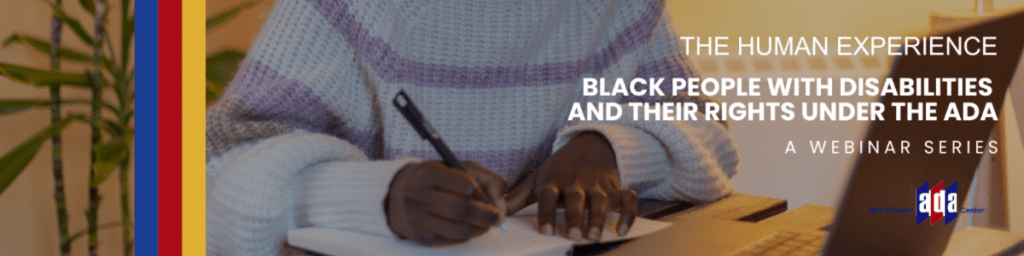
Join us as we unpack this research study and provide you with a comprehensive understanding of the opportunities, as well as the challenges and barriers, faced by Black individuals with disabilities in accessing information and exercising their rights under the Americans with Disabilities Act (ADA). By presenting the findings of this study, we will highlight the discrimination and marginalization these individuals experience, while also exploring avenues for advocacy, collective action, and support.
The Intersection of Race, Disability, and the ADA: Findings from a Focus Group Study
March 4, 2025, 12:00 to 1:00 p.m. ET
This study explores the intersection of race, disability, and rights under the ADA. On this webinar we shared key themes from the research, including the systemic barriers Black individuals with disabilities face in exercising their rights. Topics included access to information about the ADA, the role of advocacy, and recommendations to improve access, awareness, and inclusion. We will highlighted the strength and resilience of Black disabled communities, as well as strategies for collective action to address injustice.
Intersectionality: Unpacking Discrimination, Stigma, and Multiple Marginalization
June 3, 2025, 12:00 to 1:00 p.m. ET
Intersectionality recognizes that individuals hold multiple, interconnected social identities—such as race, disability, gender, and class—that interact in shaping their experiences of privilege and oppression. For Black individuals with disabilities, these overlapping identities often lead to compounded barriers in exercising rights and accessing opportunities under the ADA. This webinar will explore how these intersecting identities create specific vulnerabilities in areas like healthcare, education, employment, and public spaces. Through real-world examples, we will examine the impact of intersectional discrimination on Black disabled communities and discuss actionable strategies to address these challenges. By the end of the session, participants will be equipped with the tools to analyze and advocate for the rights of Black individuals with disabilities through an intersectional framework.
Fighting for Civil and Disability Rights: Strategies to Overcome Barriers
September 2, 2025, 12:00 to 1:00 p.m. ET
For Black individuals with disabilities, systemic barriers can present unique challenges in securing equal opportunities and exercising fundamental rights. This webinar will delve into the legal landscape of civil and disability rights, highlighting key legislation and protections. We will explore common barriers faced by individuals with disabilities, including discrimination, inaccessible environments, and lack of inclusive policies. Participants will learn advocacy strategies to overcome these obstacles, ranging from self-advocacy and community organizing to legal recourse and policy engagement.
The Power of Visibility and Community Advocacy
December 2, 2025, 12:00 to 1:00 p.m. ET
Visibility matters. When we share our stories and perspectives, we challenge stereotypes, build empathy, and inspire others to action. This webinar will explore how embracing visibility can combat the intersectional discrimination faced by Black disabled individuals. We’ll discuss how sharing your authentic experiences can spark important conversations, foster understanding, and drive social change within your communities. Learn practical strategies for leveraging your voice and platform, building alliances, and engaging in effective community advocacy to amplify your impact.
The National Council on Disability (NCD) celebrates the Americans with Disabilities Act anniversary with a virtual policy briefing series focused on ground transportation. and its July 23, 2025 advisement to federal policymakers titled:
Ground Transportation for People with Mobility Disabilities 2025: Challenges and Progress.
As July 2025 Disability Pride Month and the 35th Anniversary of the passage of the Americans with Disabilities Act draw to a close, I offer my brief thoughts and reflections as we go forward:
Brief Thoughts on the Americans with Disabilities Act 35 Years: Onward and Why
Mark Seifarth
On July 26, 1990, I was on the White House lawn with 3000 of my closest friends watching George H.W. Bush sign the Americans with Disabilities Act.
President H.W.Bush and his administration demonstrated bipartisanship in working with many legislators on both sides of the aisle in Congress in bringing the ADA to his desk to be signed into law. Many legislators, elected and appointed officials, and people with disabilities & advocates were instrumental in the passage of the ADA and I pay the utmost respect to all of them, but they are far too numerous to list. It was unifying and bipartisan across the political and disability spectrum. I submit, we must work to regain that bipartisanship in federal, state and local government.
During the July 2025 35th ADA anniversary, I have been posting many opportunities to learn about and participate in events online to grow in your knowledge of the ADA on the Ohio Disability Blog, Twitter X, and Linked In. One example providing a great deal of education and information is the Film and Panel Discussion on “Change, Not Charity: The Americans with Disabilities Act.” Congressman Steny H. Hoyer (MD-05), Congresswoman Debbie Dingell (MI-06), and the American Association of People with Disabilities hosted the event in the Capitol Visitors Center in Washington, DC. The panel discussion was moderated by Judy Woodruff and featured guest speakers Former Congressmen Tony Coelho and Steve Bartlett.
Here is a YouTube link to the two-hour film and bipartisan panel discussion: https://www.youtube.com/watch?v=GqU7EjWZkKA (If there are any difficulties with the link, please search –- discussion and screening of Change, Not Charity: The Americans with Disabilities Act –- and the search should yield a link to the film on PBS and a YouTube link to the film and panel discussion above.)
My reasons for these brief thoughts on the ADA 35th Anniversary are twofold.
First, we must learn and remember our history. As a person with a lifelong physical disability born 33 years before the ADA became law, I am now closing in on 70 years old. So, these anniversaries give us the opportunity to learn and grow from people who worked on the passage, and how that long advocacy journey resulted in the ADA. Please continue to learn. We also have entire new generations of people with disabilities and advocates who continue to push for equal access, equal treatment, and informed choices in their communities for people with disabilities. We must all mentor, educate, and support succeeding generations coming of age since 1990 as they are assuming leadership roles and championing new advocacy efforts and initiatives.
Second, in many ways the current public and policy environment should cause concern, and highlight the need to educate, inform and advocate on services and supports that help people with disabilities work, live, and grow in their own local communities. All people must have real opportunities to learn and make informed decisions about their own lives. In the current policy environment, many federal programs are being cut or combined with other programs under the guise of streamlining and efficiency when hard fought supports to work and live in your community may be diminished or not be available.
One example is cuts to Medicaid and other programs described as cuts to eliminate waste, fraud, and abuse. Now these are taxpayers’ dollars. We must be sure they are well spent and result in the legally prescribed outcomes. We must all identify misuse or abuse of tax money and correct these misuses.
But, in some ways we are not being given all the information. Yes, perhaps recent cuts in Medicaid funds and other programs are not directly in programs meant to support people with disabilities. Many of these cuts in programs will be sent to individual states to implement. With much less money available to states to administer these programs, each state must decide where to make cuts to make up for the significant reduction in federal funds. The federal government can say, they didn’t make the cuts, but they may give individual states no choice but to cut work and community programs for people with disabilities. Further, states are being forced to implement additional onerous paperwork and reapplications for services, not annually, but twice a year. This is not only costly to states but may result in loss of services due to the difficulties posed by new compliance mandates for consumers, such as additional unanticipated deadlines.
Finally, we may begin to encounter a decline in respect, understanding, and acceptance of people with disabilities – from changes in housing opportunities, to increased reluctance to any costs to fully incorporate people with disabilities in community and public life.
I believe it is not happening often at this point. But it highlights that now more than ever we must utilize all we have learned in the advocacy for and passage of the ADA of 1990. We must continuously educate, inform, and combat misinformation, or incomplete information on cuts and changes to federal, state, and local programs that support people with disabilities living, working and contributing in their local towns and cities. We must highlight how these programs give everyone the chance to work and live together in society.
Please celebrate the ADA after 35 years of law. It is a great milestone as we continue to learn and grow.
So, let me leave you with this final thought: advocacy is constant. We must continuously work to not return to the days when people with disabilities were not to be seen or were not your neighbor.
When I gave the Commencement Address at Kent State University some years ago, the title of my remarks was “The Finals are Never Over.” For as we celebrate our accomplishments and triumphs, the next challenge or opportunity to use what we have learned is just around the corner. Not to put too fine a point on it, but the fight for equal access for people with disabilities is never over.
The Revised Section 508 Standards include a requirement (503.4) where a digital product displays video with synchronized audio, the product shall provide user controls for closed captions and audio descriptions at the same menu level as the user controls for volume or program selection. The National Park Service (NPS) within the Department of the Interior (DOI) has developed an open-source media player which conforms with the Revised Section 508 Standard for user controls by ensuring that the caption control (CC) and audio description control (AD) buttons are visible along-side the other user controls.
Over several years, the National Park Service has customized a media player which aims to be as accessible as possible. It supports multi-track audio and video, allowing a user to toggle between standard, described, and American Sign Language versions of a single video; it supports captioning in over 10 languages; and has been through several rounds of user testing with people who are blind / low vision. The code for this player is available on GitHub.
Questions can be submitted in advance of the session or can be posed during the live webinar.
Video Remote Interpreting (VRI) and real-time captioning will be provided.
Continuing Education Recognition Available Certificate Credit hours: ACTCP 1.5 hours Certificate of Attendance 1.5 hours
Speakers: Alex Lindeman, IT Specialist, Section 508 Program Coordinator, National Park Service
Sid Sharma, Section 508 Program Manager, Department of the Interior
Questions for presenters:
1. You say the media player complies with Section 508, which means it is conformant with WCAG 2.0 AA. Does it meet any of the additional WCAG 2.1 and 2.2 success criteria? 2. Can you please share the link to the project on GitHub, ideally before the webinar. I have searched for it but cannot find it.
Is the media player available for others to use, such as non-profit organizations?
Is the media player available for others to use, such as non-profit organizations?
Privacy Statement
In order to register for this webinar you will need to create an account and provide, at a minimum, your name, email address, phone number, city, and country. If you do not wish to create an account, you may watch this webinar after it has been recorded. Webinars are typically posted 2 days after the live session. You can access our previously recorded webinars at this link. Be advised that in order to obtain continuing education credits you must register and create an account. See Continuing Education Recognition Request Policy.
(COLUMBUS, OH)—Ohio Governor Mike DeWine and Opportunities for Ohioans with Disabilities (OOD) Director Kevin L. Miller announced OOD’s new webinar series for 2025, which aims to foster both community and workplace inclusion for Ohioans with disabilities.
“Everyone has a role to play in making sure people with disabilities are welcomed and supported in our communities and workplaces,” said Governor DeWine. “This year’s webinar series is another step forward in our ongoing efforts in Ohio to promote inclusion and accessibility, and to empower all people to reach their full, God-given potential.”
“We invite you to join us for valuable insights on how to create communities and workplaces that are not only accessible but also embrace individuals with disabilities,” said Director Miller. “The series culminates with three webinars designed to equip employers with the tools they need to foster disability-inclusive workplaces.”
Webinar Schedule
January 15: Accessible Communications
February 19: Website Accessibility
March 19: Utilizing ADA Tools
April 17: All About Service Animals
May 21: Technology in the Workplace
June 18: Safety and Emergency Management
July 16: All About Sensory Inclusion
September 17: Disability-Inclusive Workplaces: Inclusive Leadership
October 22: Disability-Inclusive Workplaces: Attracting Diverse Talent
November 20: Disability-Inclusive Workplaces: Retaining Diverse Talent
All webinars begin at 10 a.m. and will be Microsoft Teams webinars.
Each webinar will be recorded and archived for future viewing. More information and registration links to all upcoming webinars can be found at Employer Events. People who participate in these webinars can earn professional development credits. More information is included below.
The no-cost webinar series marks the latest example of the administration’s commitment to making Ohio a national leader in accessibility.
Moments after taking the oath of office, one of Governor DeWine’s first actions was signing an executive order establishing Ohio as a Disability Inclusion State and Model Employer of Individuals with Disabilities.
Under Governor DeWine’s leadership, OOD also launched Accessible Ohio. Through this initiative, Accessible Ohio Specialists work directly with communities, businesses, and other local partners to identify opportunities to enhance accessibility.
Accessible Ohio is one of many ways OOD supports and promotes businesses that prioritize inclusivity. OOD offers a bevy of information for employers, including an Inclusive Employer Toolkit designed to help employers recruit, hire, and retain employees with disabilities and foster an inclusive workplace.
OOD also recently awarded its annual Governor’s Inclusive Employer Award, which serves as an opportunity to spotlight businesses in Ohio that go above and beyond in supporting individuals with disabilities in the workplace.
Webinar Credit Information
Each webinar has been approved for 1.00 HR (General) re-certification credit hour toward aPHR™, aPHRi™, PHR®, PHRca®, SPHR®, GPHR®, PHRi™ and SPHRi™ re-certification through HR Certification Institute® (HRCI®) and 1.00 SHRM Professional Development Credit (PDC) hour toward SHRM-CP® or SHRM-SCP®. While this training is not pre-approved for CESP Continuing Education (CE) credit, it aligns with CESP content, and verification of attendance will be provided upon request. These credits are available for attendees of the live broadcast.
Welcome to the National Trends in Disability Employment (or nTIDE) Lunch & Learn series. On the first Friday of every month, corresponding with the Bureau of Labor Statistics jobs report, we will be offering a live broadcast via Zoom Webinar to share the results of the latest nTIDE findings. In addition, we will provide news and updates from the field of Disability Employment, as well as host an invited panelist who will discuss current disability related findings and events.
12:00 pm: Introduction & Welcome Andrew Houtenville, University of New Hampshire
12:10 pm: Overview of National Trends in Disability Employment (nTIDE) Jobs Report
Release John O’Neill, Kessler Foundation
The Numbers Andrew Houtenville, University of New Hampshire
12:15 pm: Announcements from the field of Disability Employment Denise Rozell, Director of Policy Innovation, AUCD
12:30 pm: Guest Presenters
12:45 pm: Open Question & Answer period for attendees
Note. All webinars will be recorded and closed captioned and will be added to our website archives along with full transcripts following the live broadcast.
Andrew Houtenville, PhD, is a Professor of Economics and Research Director of the Institute on Disability at the University of New Hampshire. Dr. Houtenville is extensively involved in disability statistics and employment policy research. He has published widely in the areas of disability statistics and the economic status of people with disabilities. He is the Principal Investigator on the NIDILRR-funded Employment Policy and Measurement Rehabilitation and Research Training Center. Dr. Houtenville received his Ph.D. in Economics from the University of New Hampshire in 1999 & was a National Institute on Aging Post-Doctoral Fellow at Syracuse University in 1998/1999.
John O’Neill, PhD is the director of employment and disability research at Kessler Foundation and has over 28 years of experience in vocational rehabilitation as a rehabilitation counselor educator, disability employment researcher, and advisor to state vocational rehabilitation agencies. Dr. O’Neill has been a PI or co-PI on six NIDILRR funded, five-year research and training centers focusing on TBI and community integration, disability statistics, disability employment service system, and how individual and contextual factors relate to employment outcomes among people with disabilities.
Denise M. Rozell, JD is the Director of Policy Innovation at the AUCD. Prior to joining AUCD, she spent fifteen years as Assistant Vice President for State Government Relations with Easter Seals. Denise was the primary resource to Easter Seals 75 affiliates in building capacity to increase awareness of and support for Easter Seals in state government. Prior to that, Denise was the Executive Director of the Association for Education and Rehabilitation of the Blind and Visually Impaired, an international membership organization for the professionals serving individuals who are blind or visually impaired. Denise holds a bachelor’s degree in political science from Occidental College in Los Angeles and a juris doctorate from Boalt Hall School of Law at the University of California in Berkeley.
Join a “Deeper Dive” into disability statistics! Using data from a population survey released mid-month, our team of experts will explore important trends and topics with guest speakers each month.
12:00 pm: Welcome and Purpose of this Deeper Dive
12:05 pm: Updated numbers pertaining to today’s area of focus
12:20 pm: Guest Presenter
12:35 pm: Open discussion and questions for all
Note. All webinars will be recorded and closed captioned and will be added to our website archives along with full transcripts following the live broadcast.
Presenters
Andrew Houtenville, PhD, is a Professor of Economics and Research Director of the Institute on Disability at the University of New Hampshire. Dr. Houtenville is extensively involved in disability statistics and employment policy research. He has published widely in the areas of disability statistics and the economic status of people with disabilities. He is the Principal Investigator on the NIDILRR-funded Employment Policy and Measurement Rehabilitation and Research Training Center. Dr. Houtenville received his Ph.D. in Economics from the University of New Hampshire in 1999 & was a National Institute on Aging Post-Doctoral Fellow at Syracuse University in 1998/1999.
John O’Neill, PhD is the director of employment and disability research at Kessler Foundation and has over 28 years of experience in vocational rehabilitation as a rehabilitation counselor educator, disability employment researcher, and advisor to state vocational rehabilitation agencies. Dr. O’Neill has been a PI or co-PI on six NIDILRR funded, five-year research and training centers focusing on TBI and community integration, disability statistics, disability employment service system, and how individual and contextual factors relate to employment outcomes among people with disabilities.
Elaine E. Katz, MS, CCC-SLP is Senior Vice President of Grants and Communications at Kessler Foundation. Elaine Katz oversees the Foundation’s comprehensive grantmaking program and its communications department. During her tenure, the Foundation has awarded more than $49 million in grant support for national and community-based employment programs. For more than 25 years, Elaine has worked with non-profit organizations in the areas of board development, fundraising, marketing, and business development. Elaine often speaks about innovative practices for employing people with disabilities, authors/co-authors articles and papers on related topics, and is a member of several aligned organizations.
Denise M. Rozell, JD is the Director of Policy Innovation at the AUCD. Prior to joining AUCD, she spent fifteen years as Assistant Vice President for State Government Relations with Easter Seals. Denise was the primary resource to Easter Seals 75 affiliates in building capacity to increase awareness of and support for Easter Seals in state government. Prior to that, Denise was the Executive Director of the Association for Education and Rehabilitation of the Blind and Visually Impaired, an international membership organization for the professionals serving individuals who are blind or visually impaired. Denise holds a bachelor’s degree in political science from Occidental College in Los Angeles and a juris doctorate from Boalt Hall School of Law at the University of California in Berkeley.
Individuals with disabilities born after 1990 show higher employment rates than their older counterparts
July 23, 2024 – A comparative analysis of employment experiences before and after the enactment of the Americans with Disabilities Act (ADA) reveals that the “ADA generation” working-age population with disabilities (individuals born after 1990) boasts a higher employment-to-population ratio compared to the non-ADA generation with disabilities. That’s according to last Friday’s National Trends in Disability Employment (nTIDE) Deeper Dive Lunch & Learn Webinar presented by Kessler Foundation and the University of New Hampshire’s Institute on Disability (UNH-IOD).
The data also showed that the ADA generation without disabilities lags behind their non-ADA counterparts in employment rates, indicating ongoing challenges for this group. Overall, the data suggests progress in closing the employment gap between individuals with and without disabilities, largely driven by the ADA generation’s significant presence in the labor market, according to presenter Hyun Ju Kim, PhD, project director III at UNH-IOD.
Additionally, guest speaker Brittany Potvin, PhD candidate and community health worker in the Strafford County Public Health Network, New Hampshire, who is partially paralyzed as a result of a head-on collision, offered a personal overview of models of disability. She clarified the difference between ADA compliance and accessibility for people with disabilities and underscored the necessity for universal design.
ADA Generation Moves the Needle
“In 2023 to 2024, the ADA generation (people who are 34 years old and younger) had a 45% employment-to-population ratio, and for the non-ADA generation, the employment rate was far lower than that, which is 34.6%,” recounted Dr. Kim. “This has been the trend so far since the Great Recession, where the ADA generation has been driving the employment rate of people with disabilities,” she said.
Meanwhile, the overall employment rate for people without disabilities was 75.2% in 2023 to 2024. Within this group, those from the non-ADA generation had an employment rate of 79.9%, while those from the ADA generation had a lower rate of 68.4%. “This data highlights the persistent trend that the ADA generation without disabilities is less likely to be employed compared to the non-ADA generation,” asserted Dr. Kim. “Overall, it’s interesting to see the strong presence in the labor market of the ADA generation with disabilities compared to the ADA generation without disabilities,” she added.
Dr. Kim posed several hypotheses that might be driving this finding including more widely available and accepted workplace accommodations for this generation, which helps them engage in the labor market. Also, more people in this generation may be identifying themselves as disabled because the inclusion of disability in all aspects of community has helped them feel proud of their identity.
Personal Story of Resilience
Brittany Potvin shared her journey of overcoming a life-altering accident and living with visible and invisible disabilities. “Navigating life with disabilities has been challenging, but it has also given me a unique perspective on the importance of accessibility and inclusion,” she said. “The ADA has been instrumental in my ability to advocate for myself and others.” Her story underscores the importance of accessibility, inclusion, and universal design in creating equitable opportunities for people with disabilities.
“I learned that managing my disability was relative to the situation at hand. When we leave our own environments, our disabilities can become more prominent and challenging. When I’m at home, I’m not disabled because my home environment emphasizes my abilities. But unfortunately, the outside world emphasizes my limitations,” asserted Potvin.
She highlighted the ongoing societal challenges and the importance of changing perceptions. “There’s still a lot of stigma surrounding the word disabled. When we talk about accessibility, it’s often seen as a burden,” said Potvin. Working to eliminate those stigmas has been a significant focus of her efforts.
Potvin has also discovered that ADA compliance doesn’t guarantee easy accessibility for people with disabilities. Many buildings can navigate around ADA regulations and frequently qualify for exemptions, especially older, historic structures. “An idea that is still new to a lot of people is universal design, which was defined by the Centre for Excellence in Universal Design for all people, regardless of their age, size, ability, or disability,” explained Potvin.
Universal design offers significant benefits, including long-term cost savings by addressing requirements upfront, driving innovation through multidisciplinary collaboration, and engaging the workforce. “It empowers more employees to use and access content, making it easier to attract, retain, and develop employees with and without disabilities,” said Potvin. “Creating environments that are accessible to everyone, regardless of ability, not only benefits people with disabilities but also fosters a more inclusive and innovative society,” she added.
“Individuals with disabilities didn’t just appear in society yesterday, and they didn’t appear since the ADA was written into law. The battle for inclusion and accessibility has been fought for generations. My hope is that more people become aware of universal design and its benefits and that it will become the norm and there will be less hurdles for the disability community,” Potvin concluded.
Ask Questions about Disability and Employment
Each nTIDE release is followed by an nTIDE Lunch & Learn online webinar. This live broadcast, hosted via Zoom Webinar, offers attendees Q&A on the latest nTIDE findings, provides news, updates from the field, and features invited panelists who discuss current disability-related findings and events.
NOTE: The statistics in the nTIDE are based on Bureau of Labor Statistics numbers but are not identical. They are customized by UNH to combine the statistics for men and women of working age (16 to 64). nTIDE is funded, in part, by grants from the National Institute on Disability, Independent Living and Rehabilitation Research (NIDILRR) (9ORT5022 and 90RT5017) and Kessler Foundation.
About Kessler Foundation Kessler Foundation, a major nonprofit organization in the field of disability, is a global leader in rehabilitation research that seeks to improve cognition, mobility, and long-term outcomes — including employment — for people with neurological disabilities caused by diseases and injuries of the brain and spinal cord. Kessler Foundation leads the nation in funding innovative programs that expand opportunities for employment for people with disabilities. For more information, visit KesslerFoundation.org.
About the Institute on Disability at the University of New Hampshire The Institute on Disability (IOD) at the University of New Hampshire (UNH) was established in 1987 to provide a coherent university-based focus for the improvement of knowledge, policies, and practices related to the lives of persons with disabilities and their families. For information on the NIDILRR-funded Employment Policy and Measurement Rehabilitation Research and Training Center, visit www.ResearchonDisability.org.
For more information, or to interview an expert, contact:
ADA Anniversary: History of the Disability Rights Movement
Wednesday, July 24th, 2024
1:00 PM PDT – 2:30 PM PDT
Location: Online
Join us for an upcoming webinar exploring the history of discrimination and how the ADA changed the lives of people with disabilities. This session will highlight key aspects in the disability rights movement and legislation that led to greater access and inclusion.
Learning Objectives:
Learn about key moments in the history of the Disability Rights movement
Understand how the ADA has shaped disability related rights
Understand where the movement and its goals are today






 Ohio Disability Blog