Remembering a Man I Never Met: Mark Hemphill

You never know what days are going to be pivotal turning points in your life – the days that will plot your course. One of mine occurred on October 6, 1979, when I went to a college football game with my father. I was 12. On that Homecoming Saturday, Southern Illinois beat Illinois State 7-0, a detail I had forgotten until I looked it up. But it was a day I will never forget.

During the game, a player from Illinois State fumbled, and about eight guys dove on the turf for the ball. Seven of them got up. One player, wearing the maroon #30 SIU jersey, stayed down. Face down. My father, normally a talkative physician, joined the rest of McAndrew Stadium in a haunting silence. The announcer said the injured Saluki was Mark Hemphill, a player I’d never heard of before. I didn’t understand what was happening. I didn’t understand why they didn’t just help him to the sideline so they could check out his arm, or his leg, or whatever. But they just hovered around him. After ten or fifteen minutes an ambulance showed up and drove right on to the field, which I was certain was against the rules. Then they took him away on a stretcher and the game resumed. But I just sat there in a fog – wondering what had just occurred.

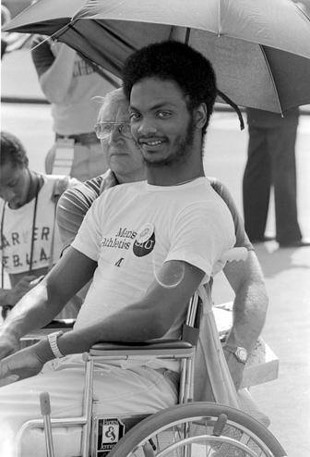
A week later they ran a feature in the newspaper saying that he had broken his neck and was a partial quadriplegic. He had no feeling from his chest down but could manage gross motor movements of his arms. Barring a miracle – which his family believed would come – he would never walk again. In a split second, Mark Hemphill had gone from star athlete to a person with a disability, right before my eyes. He left a dorm room in Carbondale for a rehabilitation hospital in St. Louis, his hometown.

Former SIU Saluki football player Mark Hemphill
Former SIU Saluki Football Player Mark Hemphill

I followed his case very closely. His care was paid for by catastrophic insurance carried by SIU for just this purpose, and his policy would end (if memory serves) after $1 million or two years, whichever came first. Mark Hemphill blew through $1 million in about 15 months. He was then left to apply for Medicaid, transferring the cost of his care to the taxpayers of Missouri. It also meant that his 24-hour care attendant would only be available to him 8 hours per day. He filed a lot of lawsuits that were unsuccessful, leaving him with a very uncertain future.

On September 13, 1980, SIU held “Mark Hemphill Day” at McAndrew Stadium. They retired his #30 jersey and all the proceeds from that game would go to Mark to help him pay his bills. And even though it was well over 90° that day, 17,150 fans showed up – the largest crowd in SIU football history. He sat in his wheelchair on the track, under the shade of a tree, due to the heat. Fans were free to go talk to him – but I couldn’t work up the nerve. I really wish I had.

Eventually Mark Hemphill settled into his new life as a person with a disability. He moved into his own apartment and took the nearly $35,000 raised from “Mark Hemphill Day” and purchased an accessible van, one where you controlled the ramp and all the electronics with a set of keys. He went back to school, studying computers at a community college. He was an inspirational figure in the disability community in St. Louis. And he was certainly a hero to one young Saluki fan back in Carbondale.

Friday, November 26, 1982 was a very cold day in St. Louis and Mark Hemphill was studying late at the library. It was the day after Thanksgiving and there weren’t many students around. He went home to his apartment, driving his van into a nearly empty parking lot. They’re not sure exactly what happened next, but the best they can figure out was that after the ramp was partially lowered, he dropped his keys.

And for Mark Hemphill, that’s all it took.

The official cause of death was listed as “exposure,” which was just a way to avoid saying he froze to death. In 1982, there were no cell phones. No one was around on the holiday weekend to hear him and his personal attendant wouldn’t be coming until the next morning. Mark Hemphill died because there was no one with him. His passing made the front page of the St. Louis Post -Dispatch and he was mourned throughout the disability community as a champion.

I’ll never forget the way I felt when I read the news. I was devastated and I just didn’t understand how these things could happen. I was only 15 when he died, but I still think about him a lot. I think about him every time a football player doesn’t get up at the end of a play. And to this day, I still get a sick feeling inside every time I drop my keys.

After I graduated from Miami, I went back to SIU and studied rehabilitation counseling, a discipline that helps people with disabilities become employable and employed. I wrote my master’s thesis about Mark Hemphill’s case and dedicated my doctoral dissertation to #30 of the SIU Salukis. Now I work helping people with disabilities get the technology they need to go to school, to get a job, or to just live independently. To be free.

I never met Mark Hemphill, because I wouldn’t go talk to him under that tree. I hope someday I’ll get to tell him how much he meant to me.

Reflections January 7, 2021 of Yesterday’s U.S. Capitol Riots

Architect of the Capitol Symbol

Reflections January 7, 2021 of Yesterday’s U.S. Capitol Riots

Those who know me/worked with me over almost 40 years of Public Policy impact, know that I have been neither the most conservative nor the most liberal. I have tried to be an honest, informational, educational voice for lawmakers to work with people with disabilities, advocates & families to craft the needed public policy and services for equal access in our communities.

While I consider myself a moderate who works hard to learn and understand both sides of an issue to help craft a useful and workable compromise, this morning I find myself seeing no compromise in the defense of our Republic and Democracy in our country.

I will not go back to our founding fathers and mothers to discuss our democracy and my current sadness on yesterday’s violent occurrences. I will simply speak of things I remember and/or I experienced – and how it illustrates disparate treatment and how we must move forward now to heal this country.

Over 30 years ago, during consideration of the Americans with Disabilities Act in Congress, people with disabilities crawled up the steps of the U.S. Capitol as it demonstrated that our crutches and our wheelchairs had limited or no access and we did not have the same rights as our neighbors in our communities.

People with disabilities have chained themselves to buses, sat in Congress, Statehouses, and government buildings to demand our rights and access – even when these rights were already in law and not being enforced or completed in the needed administrative rules. And we were arrested, dragged out in our wheelchairs – and if immovable – dragged out of our wheelchairs, taken away from our needed mobility and medical devices and arrested.

So here is my question today from an old white guy with a lifelong disability:

Why were people with disabilities arrested when we protested for our rights, but rioters who engulfed the U.S. Capitol yesterday by and large were not? They were simply herded out of the Capitol after destruction trying to stop the acceptance of the Electoral College votes for our President. (Full disclosure: so far about 50 of the thousands were arrested.)

Now, I am not a person of color, but of the thousands of persons who overran the U.S. Capitol yesterday and were not stopped or arrested by law enforcement – of all the news coverage pictures – I visually saw only one person of color. Contrast this with the many Black Lives Matter protests and the peaceful protesters in Lafayette Square near the White House who were either arrested or violently pushed out.

I’m not asking you to simply agree with me, but please quietly in your own mind and heart consider the question:  Are people with disabilities and others treated differently? Have yesterday’s riots and protests bought this treatment again into the stark light of day to be addressed? I’m just saying. . .

Former Governor/Attorney General Richard Thornburgh Dies – Bipartisan ADA Advocate

Let’s pause to remember Dick Thornburgh – who on behalf of President George H. W. Bush, worked in a bipartisan way with Democrats & Republicans in the U.S. House & U.S. Senate to help craft the Americans with Disabilities Act that President Bush supported and signed into law July 1990.
Washington Post December 31, 2020 – partial quote of complete article further below:
“…One of Mr. Thornburgh’s policy triumphs as attorney general emerged from the Justice Department’s civil rights division. He served as the Bush administration’s point man in the passage of the 1990 Americans With Disabilities Act, which broadened the scope of civil rights for people with disabilities. He reassured lawmakers wary of the cost of new regulations on businesses, countering with the benefit to productivity and the economy from contributions by workers with disabilities.

The passage had been personally satisfying for Mr. Thornburgh, whose son Peter suffered from the effects of a traumatic brain injury in a car accident in 1960. The accident had also taken the life of Mr. Thornburgh’s first wife…”

https://www.washingtonpost.com/local/obituaries/dick-thornburgh-dead/2020/12/31/b876404c-4b9d-11eb-a9f4-0e668b9772ba_story.html?s=09#click=https://t.co/Q1ewL0eoGF

Obituaries

Richard L. Thornburgh, former Pennsylvania governor and U.S. attorney general, dies at 88

By Louie Estrada Dec. 31, 2020 at 2:50 p.m. EST

Richard L. Thornburgh, a former crime-busting federal prosecutor who unflappably led Pennsylvania through the Three Mile Island nuclear crisis as the state’s two-term governor and served as U.S. attorney general from 1988 to 1991, died Dec. 31 at a retirement community in Oakmont, Pa. He was 88.

His son David Thornburgh confirmed his death but did not cite a specific cause.

In the summer of 1988, President Ronald Reagan needed to replace besieged Attorney General Edwin Meese III, who had resigned amid charges of ethics violations for mixing personal finances with government business and for allegedly helping cover up the White House’s role in the Iran-contra scandal. The administration sought a Republican with a law enforcement background and a track record of public integrity to take quick command of the Justice Department.

Mr. Thornburgh, who was tall, with a boyish, round face and horn-rimmed glasses, seemed an ideal candidate. Schooled in engineering and law, he was widely seen as methodical, effective and cool under extreme pressure.

As the U.S. attorney for western Pennsylvania from 1969 to 1975, he won convictions against organized-crime figures as well as police chiefs, city council members, mayors and other public officials who collectively took millions of dollars in bribes from mobsters.

For Mr. Thornburgh, the biggest professional challenge came not in a courtroom but rather in a trial-by-fire in crisis management when, as governor, he helped avert pandemonium during the Three Mile Island crisis in 1979, the most serious nuclear power plant accident in U.S. history.

He arrived in Washington amid high expectations to take control of a Justice Department reeling from Meese’s tenure.

Mr. Thornburgh served in the Reagan Cabinet for five months, then was asked to remain as attorney general in the new administration of George H.W. Bush even though some Republican leaders expressed doubts about his conservative bona fides. He was widely regarded as a GOP moderate, especially in contrast to Meese, a blunt and polarizing campaigner against abortion rights and affirmative action, and on other cultural flash points.

In the ensuing three years as U.S. attorney general, Mr. Thornburgh led the Justice Department during its investigation of the bombing of Pan American Flight 103 over Lockerbie, Scotland, as well as cases involving Colombian drug cartels and global money-laundering operations.

But the glare of national media scrutiny, harsh battles of political partisanship and legal turf wars took a toll on Mr. Thornburgh’s “Mr. Clean” reputation.

His department faced scrutiny for its slow pace — compared with those of state prosecutors — in pursuing prosecutions of Charles H. Keating Jr. and other fraudsters in the multibillion-dollar savings-and-loan crisis that had cost millions of Americans their life savings.

Mr. Thornburgh also was accused by congressional Democrats of protecting the White House in a tangled scandal dubbed “Iraqgate.” It appeared to involve members of the American and Italian governments, a multibillion-dollar bank fraud in the Atlanta branch of an Italian bank, and an arms buildup by Saddam Hussein’s Iraq amid the Iran-Iraq war of the 1980s.

One of the bankers went to prison for his role in making illicit loans. But the Justice Department, under Bill Clinton’s attorney general, Janet Reno, issued a report in 1995 absolving members of the Bush administration of misconduct.

One of Mr. Thornburgh’s policy triumphs as attorney general emerged from the Justice Department’s civil rights division. He served as the Bush administration’s point man in the passage of the 1990 Americans With Disabilities Act, which broadened the scope of civil rights for people with disabilities. He reassured lawmakers wary of the cost of new regulations on businesses, countering with the benefit to productivity and the economy from contributions by workers with disabilities.

The passage had been personally satisfying for Mr. Thornburgh, whose son Peter suffered from the effects of a traumatic brain injury in a car accident in 1960. The accident had also taken the life of Mr. Thornburgh’s first wife.

Richard Lewis Thornburgh was born in Rosslyn Farms, a prosperous suburb of Pittsburgh, on July 16, 1932. His family consisted almost entirely of engineers and Republican Party stalwarts.

He received a bachelor’s degree in engineering from Yale University in 1954 and graduated three years later from the University of Pittsburgh law school. He spent most of his early legal career with the law firm of Kirkpatrick & Lockhart in Pittsburgh.

He said the car accident that killed his wife, the former Virginia Hooton, and severely injured his son prompted soul-searching about his future.

He was remarried in 1963 to a former schoolteacher and three years later sought public office, running for the U.S. House of Representatives on a platform that included advocating for civil rights initiatives and de-escalating U.S. involvement in the Vietnam War. He lost the race.

In 1969, the newly elected Republican president, Richard M. Nixon, named Mr. Thornburgh the U.S. attorney for the Western District of Pennsylvania.

His diligence in prosecuting cases caught the attention of higher-ups in Washington and, in 1975, he was elevated to assistant attorney general in charge of the Justice Department’s criminal division. The next year, he helped create the public integrity section to investigate allegations of political corruption.

In 1978, he won the gubernatorial race against former Pittsburgh mayor Peter F. Flaherty. Nothing in the campaign could have prepared him for what unfolded eight weeks into his first term.

On the morning of March 28, 1979, while meeting with state lawmakers about budget issues, Mr. Thornburgh received a phone call that there had been an accident at the Three Mile Island nuclear power plant, located on a sandbar in the middle of the Susquehanna River about 10 miles downstream from the state capital, Harrisburg.

A chain of events involving mechanical failure, design flaws and human error led to the partial meltdown of the reactor core in Unit 2 at the nuclear power plant.

Mr. Thornburgh urged residents in the surrounding area to remain calm as he tried to get a grasp on what was happening at the plant. Using his prosecutorial questioning skills to cut through contradictory information during the early days of the crisis, he determined that the situation wasn’t as bad as some had feared but that government officials needed to remain vigilant.

After engineers regained control of Three Mile Island, Mr. Thornburgh led President Jimmy Carter and first lady Rosalynn Carter on a tour of the facility to help put a jittery public at ease.

Mr. Thornburgh spent many more years working on the Three Mile Island cleanup efforts, but he also focused his attention on the state’s declining industrial-based economy. He cut personal and business tax rates and balanced the state’s budgets for each of his eight years in office. He also helped forge partnerships to lure technology companies.

“He really understood the evolution of the old economy of coal, iron and steel to the new economy of finance, real estate and technology,” said G. Terry Madonna, a political scientist at Franklin & Marshall College in Lancaster, Pa. “After Three Mile Island, which he handled brilliantly, with calm and deliberate decision-making, his job approval soared.”

Prohibited by state law from running for a third term, Mr. Thornburgh was soon in Washington as the newly appointed U.S. attorney general.

In 1991, he left the Justice Department when Senate Republican leaders persuaded him to run in a special election for the U.S. Senate seat from Pennsylvania after the death of John Heinz (R-Pa.) in a plane crash. Painted as a Washington insider, he was defeated in a stunning upset by Harris Wofford, a former president of Bryn Mawr College, who rode anti-Bush sentiments to victory.

Survivors include his wife, the former Ginny Walton Judson of Oakmont; three sons from his first marriage, John Thornburgh of Wexford, Pa., David Thornburgh of Philadelphia and Peter Thornburgh of Pittsburgh; a son from his second marriage, William Thornburgh of Pittsburgh; six grandchildren; and five great-grandchildren.

Mr. Thornburgh, who became counsel to the law firm K & L Gates in Washington, continued to give speeches about the value of holding elective office.

“Democracy is not a spectator sport,” he said in a 2009 address at the University of Pennsylvania. “And politics is an honorable calling. All of us must exercise the opportunity to contribute to improving and sustaining higher levels of performance in public life. This involves much more than simply voting or even being part of a focus group or responding to poll questions. And it is just as important in contests for the local school board as in those for higher office.”

Ohio is the birthplace of vocational rehabilitation for Americans with Disabilities

After graduating from Miami University, I went back to my hometown of Carbonale to begin a master’s degree program in rehabilitation counseling at Southern Illinois University. Like rehab counseling students across the country – every year – I began by learning about the foundational laws that brought the field of vocational rehabilitation into being. There are several of these laws but chief among them was the Smith-Fess Act of 1920, the law that established the Civilian Vocational Rehabilitation program. This program was set up to help injured soldiers returning from World War I to learn new skills so they could continue to have productive lives after their military service was done.

Eventually, the Smith-Fess Act of 1920 was replaced by the Vocational Rehabilitation Act of 1973, which established the nationwide state-federal vocational rehabilitation program that we have today. Through this program, millions of Americans with disabilities have been able to receive training leading toward employment careers. Many professionals in the field today – including those from Ohio – may not realize the vital role Ohio played in establishing this incredibly important system.

Simeon Fess, one of the bill’s champions, was from Ohio. He was a graduate of Ohio Northern University and in 1907 became the president of Antioch College in Yellow Springs. In 1912, Mr. Fess ran for Congress, sucessfully, thus beginning a remarkable legislative career in Washington. He would serve 5 terms in the House of Representatives and then 12 years in the United States Senate. Along the way, he pushed through a bill – the Smith – Fess Act of 1920 – that would change the employment landscape for Americans with disabilities for generations to come. 2020 marks the 100th anniversary of passage of the Smith-Fess Act.

Opportunities for Ohioans with Disabilities – Ohio’s state-federal VR program – put out a video hosted by our governor, honoring the life and accomplishments of Simeon Fess. It turns out Governor DeWine and Senator Fess have a lot in common: They are both from Yellow Springs, they both graduated from the Ohio Northern College of Law, and they both went on to serve in Congress and the Senate. In 1998, then-Senator DeWine was given the responsibility of reauthorizing the Vocational Rehabilitation Act, the law that began with Simeon Fess’ vision for a better life for Americans with Disabilities. Senator Fess passed away in 1936 and was laid to rest in Glen Forest Cemetary in Yellow Springs – directly across the street from Mike DeWine’s childhood home.

Please enjoy this short video and be proud of the role Ohio has played in making lives better for Americans with disabilities, through the generations.

Results of The Direct Support Workforce and COVID-19 National Survey 2020

The Direct Support Workforce and COVID-19 National Survey Report 2020

The Institute on Community Integration and the National Alliance for Direct Support Professionals collaborated to lift up the voice of the direct support workforce. The aim of this study was to gather evidence about the experiences of the direct support workforce during the COVID-19 pandemic and to inform efforts to better prepare for future waves of this pandemic.

Acknowledgments

Funded by grant #90RTCP0003 from the National Institute on Disability Independent Living Rehabilitation Research and cooperative agreement #90DDUC0070 from the Administration on Community Living, U.S. Department of Health and Human Services.

Please contact Jerry Smith with questions.

Download a PDF version of the Results of the Direct Support Workforce and COVID-19 National Survey 2020

This survey was conducted jointly between the Institute on Community Integration and the National Alliance of Direct Support Professionals

https://publications.ici.umn.edu/community-living/covid19-survey/overview

https://ici-s.umn.edu/files/iJphkG6fcN/dsp-covid-survey-results

Research News @Vanderbilt – New research documents how COVID-19 multiplies stress and trauma for people with disabilities

The COVID-19 pandemic has induced stress in everyone this year, but for those marginalized by disabilities, and especially those already dealing with social inequity and poverty, the pandemic has dealt additional blows. https://t.co/0SksYj9uKm

DisabilityStatistics@disabilitystats·“As disabled people and scholars ourselves, we noticed that the disability community… [was] being uniquely impacted by the pandemic'” – Find new research out of @VanderbiltU here –http://ow.ly/wjFP50CtD0I

ODB Presents: The Ohio DD Council, Part 3… Collaboration and Action are the Keys to Success

Today we unveil the final installment of our interview with Carolyn Knight, director of the Ohio Developmental Disabilities Council. In this segment, she discusses an innovative look at providing transportation solutions for people with disabilities. In all of my different areas of work through the years, access to transportation has always been of paramount importance to people with disabilities. The Ohio DD Council helped start a program to provide more public transportation options to people living in Athens county, a primarily rural county in southeast Ohio. The key to the success of the program, Carolyn explains, is the willingness to reach out in partnership with other agencies and programs that are struggling with the same issue for their constituentcies.

Director Knight also talks about the success of the DD Council Legislative Day, where Ohioans with DD come from all over the state to a political celebration and rally, and then go out and meet with the their state representatives and state senators. It is true that two of the best “abilities” in politics are availability and visibility. To be able to share their concerns – in person – with the powers that be is an important way to help people understand the challenges facing Ohioans with DD every day. The Legislative Day has been a huge success, often featuring visits by the Governor, Lt. Governor and other statewide elected officials. It is an idea Ohio led the way on and has been adopted by many other states across the country.

We thank Carolyn for being generous with her time and for her amazing career helping people with developmental disabilities. You can learn more about the DD Council by going to their website (ddd.ohio.gov). Please enjoy part 3 of our interview with DD Council director Carolyn Knight.

Ohio Disabilty Blog Presents… The Ohio DD Council, Part 2: Turning Innovative Ideas Into Disabilty Grants

Today we are happy to present part 2 of our interview with Carolyn Knight, Director of the Ohio Developmental Disabilities Council. The Ohio DD Council is a statewide board made up of Ohioans with developmental disabilities (or family members), disability service providers, and professionals from disability state agencies. The Council takes federal money and sends it out in the form of grants to entitities in our state that are working to improve the lives of people with disabilities.

How does that happen? Where do the ideas for these grants come from? Today, Carolyn talks about the process by which Council sets the agenda and turns innovative ideas into grants that go out into the community. She also talks about a particular grant that is opening up new housing opportunities for people with developmental disabilities.

We are grateful to Carolyn for her time and her lifelong commitment to helping Ohioans with disabilities. Please take this opportunity to learn more about this wonderful program that constantly seeks out new and innovative ways to improve the lives of Ohioans with DD.

Ohio Disability Blog Presents: What is the Ohio Developmental Disabilities Council? An Interview with DD Council Director Carolyn Knight

I have been working in the disability field in Ohio since 1991. I started working as an intern at Goodwill Rehabilitation Center on Edgehill Drive here in Columbus that fall and I have been around ever since. I eventually moved on and worked as a social worker in the mental health field for a community mental health center in Columbus. I also spent several years working as a rehabilitation counselor in the workers’ compensation field, including running my own business for a few of those.

Upon coming to Ohio State, I was fortunate to be appointed by Govenor Bob Taft to serve on the Ohio Developmental Disabilities Council. I spent six wonderful years on the Council. I wound up being the chair of the Employment committee and, in the last two years, the chairman of the Council at large. It was an amazing experience. In all of the experiences I’ve had in my career, none was more valuable than the time I spent on DD Council.

What is DD Council? When I worked in other areas, I could not have answered this question. But it is an amazing group of people (31 in all), made up of people with disabilities (or family members), providers of services to people with disabilities, and professionals from state agencies that touch the lives of people with disabilities. They serve on this Council that is charged with sending out grants into the community to try and establish innovative programs to improve the lives of Ohioans with developmental disabilities.

They are brave. They will try things on a local level no one has tried before, without fear of failure. Througout the years, so many statewide (even nationwide) initiatives that have been implemented to help Americans with developmental disabilities started with a small DD Council grant. They pursue the art of the possible. They are an indispensable part of the disability community, but one that many people may not be aware of.

Today we share the first part of a 3-part interview with Carolyn Knight, director of the Ohio Developmental Disabilities Council. In this first interview, Director Knight talks about what a DD Council is, who is eligible to serve on it, what the mission of the Ohio DD Council is, and what they hope to accomplish with the grants that are established by Council.

Parts 2 will be published on December 17 and Part 3 on December 18. We thank Carolyn for her time and her lifelong commitment to improving the lives of Ohioans with developmental disabilities.

12/16/2020 2PM–National Webinar with Ohio Presenter–Learning and Leading: Service Delivery to Job Seekers in a Virtual Environment

**CLICK ON LINK JUST BELOW TO SIGN UP FOR 12/26/2020 2PM VIRTUAL WEBINAR WITH PRESENTER FROM OHIO–Area 14 Workforce Development Board, Athens, Meigs, Perry Counties**

https://olderworkers.workforcegps.org/resources/2020/12/09/18/34/Learning-and-Leading-Service-Delivery-to-Job-Seekers-in-a-Virtual-Environment

Learning and Leading: Service Delivery to Job Seekers in a Virtual Environment

WorkforceGPS is sponsored by the U.S. Department of Labor, Employment and Training Administration (ETA).

ETA-Webinar

Virtual

Wednesday, December 16, 2020 2:00 PM ~ 3:30 PM ET

With the decreased ability to deliver in-person services during the COVID-19 pandemic, workforce and training organizations have met this challenge through delivering online services.  This webinar will highlight promising practices and feature organizations that have successfully used virtual platforms to deliver workforce development services to jobseekers.  

Description

This webinar follows the kick-off Learning and Leading Recovery webinar held on November 18, that presented the important role the workforce system has in supporting job seekers and businesses through the economic recovery from the pandemic.

Moderator(s)

Eric Nelson, Director, Office of Special Initiatives and Demonstrations, U. S. Department of Labor,  Employment and Training Administration

Presenter(s)

Michele Martin, Senior Associate, New Start Career Network, John J. Heldrich Center for Workforce Development

Laurie McKnight, Director, Area 14 Workforce Development Board, Athens, Meigs, Perry Counties (Ohio)

Demetria “Lynn” Strickland, Executive Director, Aerospace Joint Apprenticeship Committee (AJAC)