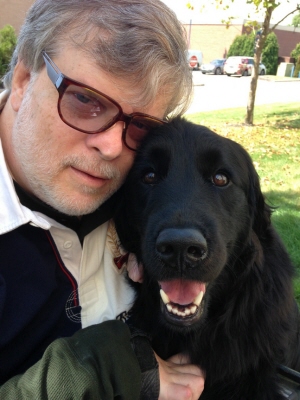
Today would have been Kevin Leonard’s 59th birthday. I just wanted to acknowledge that.
Kevin Leonard was a colleague of mine for a very long time. He worked for Goodwill / Miami Valley Easter Seals in Dayton, and ran a program that was similar to ours in many ways. His program, Assistive Technology Services, allowed citizens of the greater Miami Valley have access to the types of technologies they needed to go to school, succeed in the workplace, and live more independent and inter-connected lives. Hundreds of people with disabilities got their first computer from Kevin Leonard. We were proud to support his program with an annual grant for the better part of 10 years. I learned a lot from him.
Kevin spent most of his adult life in a wheelchair. It is an understatement to say that it is not good for one’s health to spend most of your life in a wheelchair. He frequently battled health issues and would have to temporarily leave the store in the capable hands of his wife, Diana. It is amazing he lived this long, but Kevin Leonard had uncommon strength and perseverance. He was an incredibly hard worker and I can honestly say I’ve never seen anyone with Kevin’s physical challenges who had a more productive life. He was a marvel to me. He accomplished more than I would have ever thought possible for him.
Rest in peace, Mr. Leonard. Well done. Thank you for everything you did in this life to help Ohioans with disabilities.
(CNN)A federal judge has ruled that Texas’ ban on mask mandates in schools violates the Americans with Disabilities Act, according to court documents filed Wednesday in US District Court for the Western District of Texas.
The ruling follows months of clashes between state and local leaders over mask mandates in schools — not just in Texas, but across the country. Similar mandates became the topic of heated debates earlier this year as the Delta variant sent Covid-19 case numbers surging once again and schools across the United States began to reopen while many students were still ineligible for a vaccine.
According to the court documents filed Wednesday, Texas independent school districts could choose whether to implement mask mandates for in-person instruction during the 2020-2021 school year. But before the new school year, Texas Gov. Greg Abbott issued an order which, among other things, prohibited public schools from requiring students, staff and visitors to wear masks in their facilities.
“Texans, not government, should decide their best health practices, which is why masks will not be mandated by public school districts or government entities,” Abbott had said in May. “We can continue to mitigate COVID-19 while defending Texans’ liberty to choose whether or not they mask up.”
But as the state grappled amid a nationwide spike in cases and hospitalizations over the summer, some school districts sought out ways around the ban or chose to ignore the governor’s order in hopes of curbing the spread of the virus.
Disability Rights Texas, an advocacy group, filed a federal lawsuit on behalf of several Texas families against the governor, Texas Attorney General Ken Paxton and Texas Education Agency Commissioner Mike Morath, claiming the spread of the virus was posing “an even greater risk for children with special health needs.”
“Children with certain underlying conditions who contract COVID-19 are more likely to experience severe acute biological effects and to require admission to a hospital and the hospital’s intensive-care unit,” the lawsuit said. “This includes children with conditions including, Down syndrome, organ transplants, lung conditions, heart conditions, and weakened immune systems.”
The ruling signed by US District Court Judge Lee Yeakel says that “at issue is whether Governor Greg Abbott’s Executive Order GA-38 violates Title II of the Americans with Disabilities Act of 1990.”
“The evidence presented by Plaintiffs establishes that Plaintiffs are being denied the benefits of in-person learning on an equal basis as their peers without disabilities. The court concludes that GA-38 violates the ADA,” the ruling said.
Following the judge’s decision, the Texas attorney general wrote on Twitter, “I strongly disagree with Judge Yeakel’s opinion barring my office from giving effect to GA-38, which prohibits mask mandates imposed by government entities like school districts.”
“My agency is considering all legal avenues to challenge this decision,” the attorney general wrote.
The ruling also follows a September announcement from the US Education Department’s civil rights enforcement arm that it was opening an investigation to determine whether the state’s school mask mandate ban was preventing school districts from “considering or meeting the needs of students with disabilities.”
At the time, the department said in a letter to Morath it was “concerned that Texas’s restriction on schools and school districts from putting masking requirements in place may be preventing schools in Texas from meeting their legal obligations not to discriminate based on disability and from providing an equal educational opportunity to students with disabilities who are at heightened risk of severe illness from COVID-19.”
The Ohio Tech Ambassador Network announces that the Ohio Tech Ambassador program is ready to grow. The grant funding the program has been renewed for an additional two years. The Network will continue encouraging people with developmental disabilities to use technology until June 2023.
The Ohio Tech Ambassador Network intends to hire two to three new Tech Ambassadors this fall and is reaching out for help spreading the work about this employment opportunity.
Do you, or does anyone you know, use technology to live more independently and enjoy sharing your experiences with others? If so, please read the Position Description, fill out the Application at ohiotechambassadors.org and send it to: info@ohiotechambassadors.org
The Ohio Tech Ambassador Network looks forward to adding some new tech stories to the great ones already being told by their current Tech Ambassadors.
United States Society for Augmentative and Alternative Communication (USSAAC) has launched a new campaign called “Amplifying AAC Voices,” designed to provide people who rely on AAC more opportunities to be heard. The initial initiative involves the creation of an online “AAC Speakers Connection,” a web portal that facilitates the matchmaking between AAC Speakers and those that wish to engage them as paid speakers for a wide variety of purposes.
If you know of any adults who use AAC and enjoy public speaking that would like to join USSAAC’s AAC Speaker Connection, please encourage them to sign up at https://speaker.ussaac.org/
Also, Just FYI from this non-profit —
Their first fundraiser is a Virtual Auction, October 1-15, 2021.
In addition to presentation videos, conference handouts and a complete list of TechSummit 2021 vendors & their websites are available.
As I was reviewing the information from the 2021 TechSummit Conference, and the many technological advancements that give people with disabilities more options to live independently with supports, I am reminded of the importance of a piece of technology much earlier in my life.
Or as Billy Joel put it in part of a well-known song lyric –
“… I knew it complete When I wore a younger man’s clothes …”
I am reminded of a portable transistor radio with a single ear earpiece.
Why am I bringing forward this decades old technology when the 2021 TechSummit was discussing some of the newest technology? Please journey with me for a few moments.
Over my numerous surgeries and medical procedures as a person with Cerebral Palsy, many of them entailed 3-4 months or more far away from home in the hospital. Many times, television was only available for an hour or two in the evening. And, as I again betray my age, smart phones and the internet were many, many years away.
But I could have a portable handheld transistor radio with a single ear earpiece – about the size of a small paperback book.
This gave me access to the outside world and intellectual stimulation at a time when most of my energies were taken up with surgery, post-surgical physical challenges joined by considerable pain and rehabilitation. The radio allowed me intellectual freedom with news, sports, music, talk shows and the like from local stations. In a time when physical focus and recuperation was the top priority, this now simple technology kept my thinking brain engaged and kept my energy up for the next day’s physical therapy (also, it gave the nurses, aides, janitors, cooks, and other staff a rest from my constant questions and discussion as I tried to keep my thinking up to date in addition to physical improvement).
Okay, before I relate this discussion back to the 2021 TechSummit, let’s answer the question: WHAT’S THE MOST FREQUENTLY MANUFACTURED ITEM IN HISTORY?
As you may have guessed, it is the transistor (although it may not now be the same type as in my handheld radio).
In a 2018 article, computerhistory.org says “MOS transistors are microscopic electronic devices that serve as the fundamental building blocks of silicon computer chips. Millions could fit inside the period at the end of this sentence.”
It goes on to say, “In 2014 industry analyst Jim Handy estimated that 2.9 sextillion transistors had been manufactured by the industry since the first one sprang to life in late 1947. A sextillion is one followed by 21 zeros—that’s orders of magnitude greater than the number of stars in the Milky Way. He recently updated the total to 13 sextillion. As modern graphics and artificial intelligence chips each contain billions of transistors the total continues to build at an astronomical rate.”
Last point, how does my trip down transistor radio memory lane and the 13 sextillion transistors made as of 2018 relate to the 2021 TechSummit and new possible choices for people with disabilities to live more independently with supports and help from the latest technology?
First, listen to some or all the presentations from the TechSummit conference at the link above.
Next, I submit for your consideration that this new technology has the potential to change, support and enrich our lives as people with disabilities in the same way my transistor radio gave me freedom and choices in a time in my life when my choices were not that numerous.
Don’t be afraid of these new technologies and just say I want to keep things the way they are. Learn all you can. That’s what events like the TechSummit are all about (and thanks to all the sponsors you’ll see on the website for making the conference possible). Ask a lot of questions. Try out new things to see if they will work for you.
This new technology might just give you access and support the same way my little radio did so many years ago.
Mannington Mills is an international company that makes fine floor tiles with several plants, including one in Madison, Georgia. In March of 2020, an employee started feeling poorly, went to the hospital and tested positive for Covid19. The HR department at Mannington then started to interview people regarding possible close contacts. That’s when things got interesting.
One of the people interviewed was the gentleman’s sister, who also worked at Mannington. They asked her if she had visited his work station during his last shift, and she said no. They then asked her if she had any other close contacts with him, and again she said no. The next day, however, HR called her and said a few witnesses had seen her talking with her brother for several minutes, while he sat in the car and she stood just outside the open window.
She claimed she forgot about that conversation and apologized and was subsequently sent home to quarantine for 14 days. She claimed in later court filings this action made her feel “diseased and discarded” which, if nothing else, is an excellent use of alliteration. The following day, HR called her and told her they felt she had been dishonest with them regarding the conversation, rather than the innocent forgetting she professed. One day later she was fired from Mannington Mills.
The woman sued under the Americans with Disabilities Act (ADA), claiming she was fired because she was the sister of someone who had tested positive for Covid19. Remember, this case originated in March of 2020, when people were on edge about Covid and so much was unknown. Even given that, her claims seem legally dubious.
The ADA was passed during the heights of the AIDS epidemic in our country. It was an unknown disease, and a scary one. There was a powerful social stigma associated with having AIDS and, in the early stages of the epidemic, there was no cure or effective treatment. People weren’t just being fired for having AIDS – they were, in some cases, being fired because the employer THOUGHT they MIGHT have AIDS. In this scenario, the ADA covers them if they are perceived to have the disability (even if they do not) and face discrimination based on that assumption.
I don’t think that argument applies here. Covid19 is indeed serious. Approximately 1.6% of the people in Georgia who tested positive for Covid ended up dying of it. But for the overwhelming majority of people who contracted Covid, they were sidelined for a couple of weeks and then recovered. Many were asymptomatic. By comparison, when AIDS came along, contracting it was assumed to be a death sentence.
In the 40 years since the beginning of the AIDS epidemic (as of 2018) approximately 700,000 Americans have died of AIDS, which is strikingly similar to the amount of people killed by Covid in the past 18 months (682,569, as of this writing). But contracting a disease – even one that can be fatal – doesn’t automatically (or even generally) make you a person with a disability. And yes, while people in 2020 or 2021 would keep their distance from someone who has Covid, there is simply no comparison between this type of public health decision and the stigma attached to contracting AIDS 30 years ago. Her feeling “diseased and discarded” because she was asked to quarantine doesn’t measure up.
The plaintiff’s brother got Covid. There is no indication that Mannington Mills fired him for it. And while it is possible he could have long-term effects from Covid that might render him a person with a disability someday, there’s no indication that this is the situation now. Absent evidence to the contrary, he appears to NOT meet the definition of a person with a disabilty under the law. And, even if he did, there is no indication in that the employer fired his sister (and not him) because he got Covid.
It’s possible she may have a case for wrongful termination. I’m not a lawyer, but getting canned for forgetting you talked to your brother seems a tad harsh. But her brother getting Covid doesn’t make her a person with a disability, or give her coverage under the ADA. The case was dismissed.
I received this note from Dr. Shengli Dong, from the Department of Educational Psychology and Learning Systems at Florida State University. He is a leading researcher on the incredibly important topic of transitioning to work and post-secondary education for people with disabilities. He is looking for people with disabilities to fill out a survey regarding employment outcomes.
Clinical research on the employment of people with disabilities is so incredibly important. It is an area of life where there is so much more progress left to be made. If you are a person with a disability, please consider taking the survey (you can even win a $20 gift card!). If you are not, please forward it on to someone who is. Thank you!
“You are invited to participate in a study on resource seeking strategies and impact on employment outcomes among individuals with disabilities. The study is conducted completely online and will be kept confidential. To participate you must be an individual with disability, at least 18 years of age, and will work either fulltime or parttime. The survey should take about 10-15 minutes of your time. You will be given the opportunity to opt into a raffle for a $20 gift card (given to approximately one of every 25 participants). This study has been approved by the FSU Internal Review Board as part of the research requirements. If you have any questions about the research study or need an alternative survey format, please contact Dr. Shengli Dong by e-mail: workplace_accommodation@fsu.edu
From Franklin County Board of Developmental Disabilities “NewsBits”
Nisonger Photo Contest–Deadline August 1
The Nisonger Center at The Ohio State University has extended its deadline for the annual ‘In Sights’ Photo Contest. Enter for a chance to win up to $500. This year’s theme is Sports and Play Activities. For additional details, call 614-685-3196 or click below: http://nisonger.osu.edu/photocontest
Self Advocates Wanted to Participate in Nisonger LEND Program
Nisonger Center is recruiting for two self-advocates to participate in the LEND (Leadership Education in Neurodevelopmental Disabilities) as trainees. Trainees learn about disability, advocacy and will participate in a leadership project. Trainees are paid for 10 hours of work per week. Letters of interest and resumes can be sent to christine.brown@osumc.edu or call 614-688-8472 for more information.
‘Crip Camp’ the Oscars and the tenancy of one legendary activist
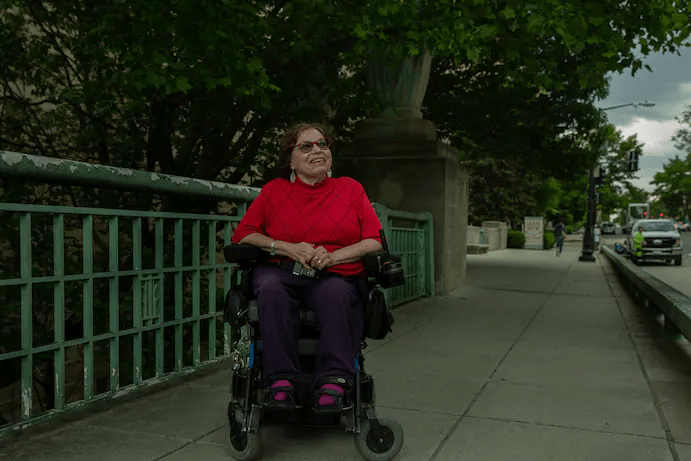
Disability rights advocate Judy Heumann in Washington, where she has lived since 1993. (Shuran Huang/For The Washington Post)
By David A. Taylor May 25, 2021 at 9:00 a.m. EDT
From May 30, 2021 “The Washington Post Magazine”
Judy Heumann’s pandemic year started off extremely well. In late January 2020, she attended a Sundance screening of “Crip Camp,” a documentary about disabled young people — including her — who, after meeting at a Catskills summer camp run by hippies in the 1970s, went on to shape the disability rights movement and change federal law. It was a surprise hit and became an Oscar nominee for best documentary.
The following month, she published a memoir called “Being Heumann.” (She hadn’t known when the film would be released, so the timing was a coincidence.) Publishers Weekly hailed the book as “thoughtful and illuminating.”
Then, just days before the world shut down, Heumann — who has made her home in D.C. since 1993 — joined Trevor Noah on “The Daily Show.” At one point in the interview, Noah called her a “badass” and asked her about the time, in 1972, when she “decided to shut New York down” with a disability rights protest.
In the midst of their friendly exchange, however, Noah made a reference to “able-bodied” people — and Heumann doesn’t like that term. “I call you ‘non-disabled,’ ” she said with a smile, “because the likelihood of you acquiring a disability, temporarily or permanently, is statistically very high.” A slightly dazed look crossed Noah’s face. “Did you just threaten me?” he asked, deadpan.
If “Crip Camp” and Trevor Noah introduced Heumann to a wider audience, then it’s arguably about time. Susan Mizner, director of the American Civil Liberties Union’s Disability Rights Program, calls Heumann “the mother of the disability rights movement in so many ways” — an activist “who doesn’t take crap, never has.”
Unable to walk since before age 2 because of polio, Heumann, now 73, grew up in Brooklyn, where she felt championed by her parents. Werner and Ilse Heumann were German Jewish immigrants who lost family in the Holocaust. In the early 1950s they didn’t know about access for disabled kids, but they knew their daughter was going to school. When they took her for her first day, however, the school principal physically blocked them at the entrance, saying Judy was a fire hazard.
America then had no room for disability, and the Americans With Disabilities Act was still four decades away. Judy’s father worked long hours at a butcher shop, so the “day-to-day work of fighting fell on my mother,” Heumann writes in her book. “Telling Ilse Heumann that something wasn’t possible was a big mistake.” Dubbed Mighty Mite by her husband, Judy’s mother simply didn’t hear the word “no.”
As an adult, Heumann continued the fight her mother had started — for instance, suing the New York Board of Education when it denied her application to be a teacher. It was a lawsuit, she told me, that even the ACLU wouldn’t take back then. Yet when the case came before Constance Baker Motley, a civil rights pioneer turned District Court judge, she agreed to hear it. New York settled and gave Heumann a job.
Heumann laughs in discussing stories that back up her badass rep: shutting down traffic in Manhattan (to protest Richard Nixon’s veto of the 1972 Rehabilitation Act), getting hauled off an airplane by security (for insisting she had a right to her seat) and launching a sit-in at a federal building in San Francisco, with meals provided by the Black Panthers, to try to get a crucial section of the revived Rehabilitation Act enforced and end discrimination against people with disabilities.
From 2010 to 2017, Heumann served as special adviser on international disability rights at the State Department, working to make disability part of the department’s agenda and to pass an international treaty similar to the Americans With Disabilities Act. More than 180 countries have ratified the 2006 convention, but not the United States because of political division. How to get it ratified? You get around the nos, like her mother did, says Heumann. “You figure it out.”
New challenges continue to arise: The pandemic, Heumann, notes, has amplified the issues faced by many in the disabled community. For people who need help getting dressed, bathing, cooking or going to the bathroom, the coronavirus and the shutdown created “definitely a more difficult situation” by making it tougher to find helpers who could come into the home. Some disabled friends of Heumann and her husband, Jorge Pineda — who also uses a wheelchair because of a spinal cord injury — had to leave D.C. to live with family elsewhere.
At a Q&A after a Sundance screening of “Crip Camp,” someone asked: “Why didn’t we know this story?” In our conversation, that question brought Heumann back to her exchange with Trevor Noah, and a truth it revealed. She was taken up short when he pronounced himself “threatened,” but then saw an honesty in that. That’s because non-disabled people do feel threatened, she told me. “It’s one of the big reasons why really getting meaningful, engaged discussion” about disability is difficult. Most people avoid what they feel threatens them — what they don’t know.
At the Academy Awards, Heumann — wearing a custom Markarian silk suit — joined “Crip Camp” co-directors Jim LeBrecht and Nicole Newnham on the red carpet. Although they would, in the end, leave the Oscars without a statue, Heumann says the film “still won because it’s gotten where it is”: a top feature streaming on Netflix in 29 languages globally with subtitles for the deaf and hard-of-hearing, and audio description available in 15 languages.
And if seeing Heumann’s story on-screen brings viewers closer to understanding disability, then it wouldn’t be the first time she has changed minds: During a conversation this spring on her podcast, “The Heumann Perspective,” LeBrecht — who was a few years younger than Heumann when they met at Camp Jened — credited her with inspiring his activism. “You’re the reason I got involved with disability rights,” he said. “And that never left me, and it’s the reason that I didn’t want this story to be lost to history.”
 Ohio Disability Blog