Public comment invited on the impact of AI on accessibility and people with disabilities until 10/31/24

The period for submitting written public comments on the impact of AI on accessibility and people with disabilities has been extended to October 31, 2024.

Throughout the month of August, the U.S. Access Board held a series of public hearings on the impact of artificial intelligence (AI) on people with disabilities.

Link to more information on August 2024 public hearings: https://www.access-board.gov/news/2024/08/28/u-s-access-board-holds-public-hearings-as-part-of-developing-artificial-intelligence-ai-equity-access-inclusion-for-all-series/

Link to U.S. Access Board YouTube Channel with recorded public hearings: https://www.youtube.com/channel/UC5tRWTtV5eSw68N3tSpmyWw

Written public comments will continue to be accepted until October 31, 2024

  • Email public comments to events@access-board.gov.
    • Include “AI Written Comment” in the subject line.
    • Include your name, organization if applicable, and specific AI topic with your comment.
    • Written comments are limited to 300 words.
  • Public comments may also be submitted via the Access Board’s docket on Regulations.gov.

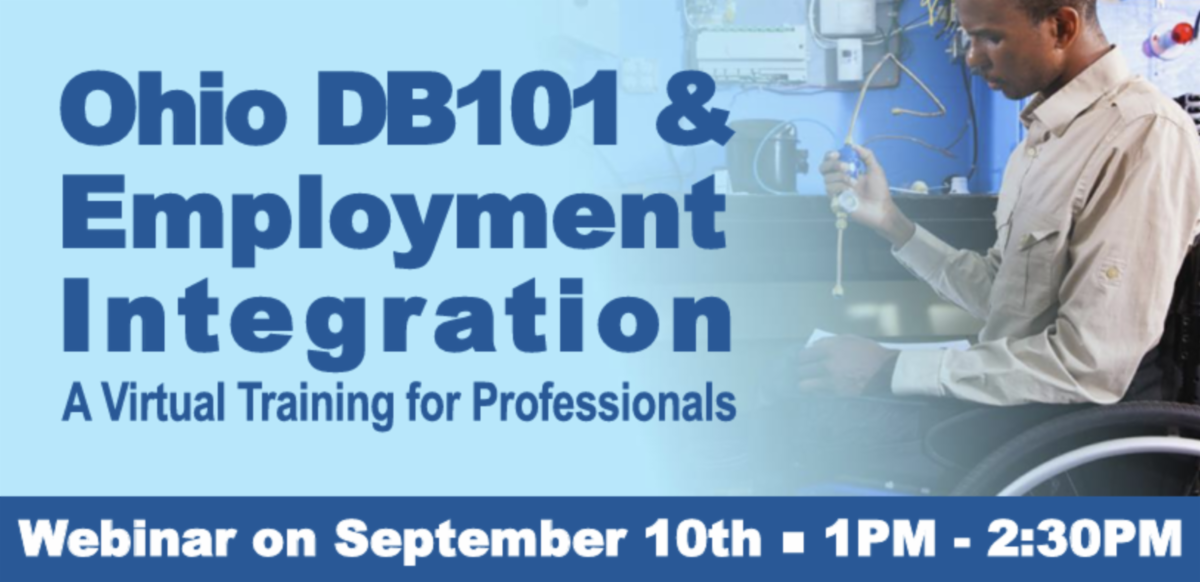
Virtual Training 9/10/24 1-2:30pm ET: Ohio Disability Benefits 101 & Employment Integration

“Understanding benefits, including Medicaid, SSI, and SSDI, was identified as a significant need,” — Ohio Developmental Disabilities Council 

Background – While this training is focused toward professionals working with people with disabilities, the training may be of value to everyone. The information provided demonstrates the significant need to understand Medicaid, SSI, SSDI, and other benefits as identified by the Ohio Developmental Disabilities Council.

Learn from the World Institute on Disability on how to utilize the tools, features, and content within OH DB101 to provide information about career-planning, public benefits, health coverage, and wealth-building decisions that motivate and support employment and transition to a more financially secure life.

When: Tuesday, September 10, 2024 from 1PM to 2:30PM

Where: online via Zoom

Register here: https://us02web.zoom.us/webinar/register/WN_clizmY5HSmW2_6zgwkvD6Q 

Learn how to utilize the tools, features, and content within OH DB101 to provide information about career-planning, public benefits, health coverage, and wealth-building decisions that motivate and support employment and transition to a more financially secure life.

Register Here:

https://us02web.zoom.us/webinar/register/WN_clizmY5HSmW2_6zgwkvD6Q#/registration

Ohio DB101 & Employment Integration Additional information about OH DB101 announcement
For more information send an email to gina@wid.org.
This project is supported by the Ohio Developmental Disabilities Council, under grant number 2301OHSCDD from the Administration for Community Living (ACL), U.S. Department of Health and Human Services (HHS), as part of a financial assistance award totaling $2,846,720 with 96% funded by ACL/HHS and 4% funded by the State of Ohio. Grantees undertaking projects with government sponsorship are encouraged to express freely their findings and conclusions. Points of view or opinions do not, therefore, necessarily represent the official views of, nor an endorsement, by ACL/HHS, or the U.S. Government.Ohio Developmental Disabilities Council | ddc.ohio.gov       

nTIDE Lunch & Learn Webinar – National Trends in Disability Employment – 09/06/24 12-1pm

nTIDE Lunch & Learn-Season 9 Episode 9

Friday, September 6, 2024 | 12:00 p.m. – 1:00 p.m. (ET)

Register Now – Free – https://unh.zoom.us/webinar/register/WN_524WzzT_SQiGzAbajDHYpQ?mc_cid=36f32c23b9&mc_eid=57377cc242#/registration
Welcome to the National Trends in Disability Employment (or nTIDE) Lunch & Learn series. On the first Friday of every month, corresponding with the Bureau of Labor Statistics jobs report, we will be offering a live broadcast via Zoom Webinar to share the results of the latest nTIDE findings. In addition, we will provide news and updates from the field of Disability Employment, as well as host an invited panelist who will discuss current disability related findings and events.

12:00 p.m.
Introduction & Welcome

12:10 p.m.
Overview of National Trends in Disability Employment (nTIDE) Jobs Report

12:15 p.m.
Announcements from the field of Disability Employment

12:30 p.m.
Guest Presenter: Kelly Israel, National Disability Rights Network (NDRN)

12:45 p.m.
Question and Answer for Attendees

Note: All webinars will be recorded and closed-captioned and will be added to our website archives along with full transcripts following the live broadcast.  

Register Now – Free – https://unh.zoom.us/webinar/register/WN_524WzzT_SQiGzAbajDHYpQ?mc_cid=36f32c23b9&mc_eid=57377cc242#/registration

The StatsRRTC is funded by a grant from the National Institute on Disability, Independent Living, and Rehabilitation Research (NIDILRR grant number 90RTGE0005).

Copyright © 2024 Institute on Disability, All rights reserved.

Our mailing address is: Institute on Disability 10 West Edge Drive Suite 101
Durham, New Hampshire 03824

For more information on each month you can visit https://www.researchondisability.org/ntide-episodes-list

Free on YouTube 09/04/24@12 Noon: Advocacy Without Animosity: Restoring Civility to Public Institutions

Columbus Metropolitan Club: YouTube Link for 09/04/24 at 12 NOON:

https://www.youtube.com/channel/UCTagQr-YfniHI8C5nVH2d9w

Chief Justice Thomas J. Moyer Legacy Series

In today’s polarized landscape, can we still have constructive bipartisan dialogue, especially with a contentious election season underway? Are good-faith discussions across divides even possible in America’s white-hot political climate? Our panelists say not only are they possible, they’re essential if our democracy is to survive and thrive. By fostering respect and understanding – and most importantly, by truly listening to one another – we can still bridge gaps, collaborate, and succeed. Join us with an incredible panel of public servants who believe bipartisan dialogue in a democratic society is both possible and indispensable.

Featuring:

Lee Fisher, Former Ohio Attorney General, and Dean and Joseph C. Hostetler-BakerHostetler Chair in Law, Cleveland State University College of Law;

Betty Montgomery, Former Ohio Attorney General, and Of Counsel, Mac Murray & Shuster;

Nancy Rogers, Former Ohio Attorney General, and Professor Emeritus and Director of the Law and Leadership Program, The Ohio State University Moritz College of Law;

Moderator Judge Laurel Beatty Blunt, 10th District Court of Appeals, State of Ohio.

Columbus Metropolitan Club: YouTube Link for 09/04/24 at 12 NOON:

https://www.youtube.com/channel/UCTagQr-YfniHI8C5nVH2d9w

Zoom Meeting 09/03/24 1-3p.m. Ohio Olmstead Task Force – Direct Care Crisis Workgroup

The Ohio Olmstead Task Force is having a direct care workforce crisis workgroup meeting Tuesday, September 3, 2024 from 1-3 p.m. on Zoom.

The discussion will feature Teresa Kobelt, Chief Innovation Officer, and Pete Moore, CEO & President of Ohio Provider Resource Association (OPRA), with additional agency representatives to be confirmed.

The meeting will address abuse and neglect within DODD systems for individuals with intellectual or other developmental disabilities (I/DD) and developmental disabilities (DD). Individuals with lived experience are encouraged to join, and privacy will be respected through non-recording and options to remain anonymous.

Minutes will exclude personal stories and identifying details, capturing only factual information from agency representatives. Workgroup members will be named, while other participants will be listed by number.

Topics of focus include:

  • UIs and MUIs
  • Agencies and Caregivers
  • Outcomes of Abusive Caregivers
  • Resources and Supports
  • Retaliation
  • Grievances
  • Competency

If you require accommodations to participate in this meeting, please email: Maria Matzik at maria.matzik@acils.com, or Georgie Elson at georgie.g.elson@gmail.com.  

Meeting link: https://us02web.zoom.us/j/89993296216?pwd=b25pc3VhZTdCZE9neVpSd0RvdmVaZz09 

Proposed Medicaid Level 1, Individual Options, and SELF Waiver Amendments Posted for Public Comment until 09/29/2024

Medicaid Waivers Posted for Public Comment

The Level 1 waiver, Individual Options waiver, and SELF waiver amendments proposed for adoption on January 1, 2025, are a result of stakeholder engagement between the Ohio Department of Developmental Disabilities (DODD), the Ohio Department of Medicaid (ODM), families and individuals, advocates, and associations.  

DODD is seeking your input on these applications; information on how to submit your comments can be found at:

https://dodd.ohio.gov/waivers-and-services/Waiver+Amendments/Waiver+Amendments+2025

As part of the waiver amendment process, the public can comment on the proposed amendment. The public comment period is August 30, 2024, to September 29, 2024. Comments must be received by midnight on September 29, 2024.

REMINDER: August 22 – U.S. Access Board Hearings on Artificial Intelligence (AI) for Disability Community and AI Practitioners

As part of the Developing Artificial Intelligence (AI) Equity, Access & Inclusion for All Series, the Access Board is holding public hearings with members of the disability community, Federal Agency AI leaders, and AI practitioners.

This series stems from the Board’s Memorandum of Understanding with the American Association of People with Disabilities (AAPD) and the Center for Democracy & Technology (CDT).

In total, three virtual hearing sessions will take place: two were held for the disability community on August 8, and one will be held for federal agency and AI industry practitioners on August 22.

Attending the Federal Agency and Industry Practitioner Hearing:

No pre-registration is required to attend the hearing. Individuals who want to make a public comment are required to register via the instructions linked below. Please note that space is limited and excess registrants may need to be waitlisted. Registered speakers will each be allotted two minutes to present comments.

TO WATCH PREVIOUS AUGUST 8th MORNING & AFTERNOON HEARINGS:

U.S. Access Board Video of August 8 Disability Community Hearings on Artificial Intelligence (AM & PM Sessions) on YouTube Website:

https://www.youtube.com/@u.s.accessboard7394

https://www.youtube.com/watch?v=fokFx-nsL1o

https://www.youtube.com/watch?v=udi5eXFSUiM

August 28 Webinar: Working From Home with Ticket to Work

Working From Home with Ticket to Work

Want to work from home? If you’re looking for a job and have questions about employment opportunities, a Ticket to Work service provider can help!

Work Incentives Seminar Event (WISE) webinar on August 28 at 3 p.m. ET to learn how Ticket to Work service providers can help you find and keep a work from home position.

During the webinar, learn more about:

  • Types of work from home opportunities
  • Successfully working from home
  • How to connect with Ticket Program service providers

Register Now

https://choosework.ssa.gov/wise/register

Online: choosework.ssa.gov/wise/

By Phone: 1-866-968-7842 or 1-866-833-2967 (TTY)

Work Incentive Seminar Event Details

08/28/24: Working From Home with Ticket to Work

08/28/2024 – 3:00 p.m. – 4:30 p.m. Eastern

Email: support@choosework.ssa.gov

Phone: 1-866-968-7842

TTY: 1-866-833-2967

You will receive a registration confirmation message with instructions on how to log in to the webinar. Please be sure to check your spam folder.

WISE in American Sign Language (ASL) – Our ASL Guide can help individuals who are deaf or hard of hearing access our monthly WISE webinars using Video Relay Services (VRS).

Additional accessibility information is available on the registration page.

Questions about Ticket to Work?

The Ticket Program supports career development for people ages 18 through 64 who receive Social Security Disability benefits (SSDI/SSI) and want to work. Monthly WISE webinars provide information about Social Security programs, Work Incentives and other resources that may help you or someone you know on the path to financial independence through work.

Email us: support@choosework.ssa.gov

Call us: 1-866-968-7842 or 1-866-833-2967 (TTY)

Visit our website: choosework.ssa.gov

How Proposals to Eliminate U.S. Dept of ED Could Impact People with Disabilities – Mark E. Seifarth

How Proposals to Eliminate U.S. Dept of ED Could Impact People with Disabilities

Mark E. Seifarth

Every two to four years as people are running for state and federal offices, politicians and hopeful politicians put forward ideas for drastic cuts in federal programs under the guise of returning responsibility to the states – of course usually cutting the funding significantly so the programs can no longer be maintained.

While many times this could be a good starting point for productive discussions to improve programs and make the best use of limited tax dollars, currently the U.S. Department of Education is being targeted for complete elimination in written proposals.

When I was in graduate school years ago, some similar proposals were called “The New Federalism” which I saw as simply block granting program responsibilities back to the states and cutting the funding by half to cut the federal budget. As the federal government was in bipartisan hands at the time, program changes were debated at length and changes were made responsibly and not by meat axe.

It is important that people with disabilities and all advocates realize the possible impact on their lives, especially in their formative school and preparing for jobs years.

Very briefly, here are just a few of the programs targeted for elimination or block granting to the states for oversight with I believe greatly reduced funding over time:

  • Cuts to free school meals programs
  • Eliminates the Head Start program providing comprehensive early childhood education, health, nutrition, and parent involvement services to low-income children and families.
  • Proposes eliminating the Department of Education and allowing states to opt out of federal programs or standards.
  • Programs under the Individuals with Disabilities’ Education Act (IDEA), which provides $14.2 billion in federal money for the education of school-aged children with disabilities, would be mostly converted to “no-strings” block grants to individual states and distributed directly to local education agencies by Health and Human Service’s Administration for Community Living
  • Office of Special Education and Rehabilitative Services (OSERS) supports federal efforts to enforce our laws against discrimination of individuals with disabilities, those assets would be moved to the Department of Justice (DOJ) along with the Office for Civil Rights (OCR). The OCR at DOJ should be able to enforce civil rights protections only through federal courts and litigation.

As you recall, for vocational rehabilitation, every state dollar is matched with almost four federal dollars (21.3% state funds matches 78.7% federal funds). Without federal match most state rehabilitation programs for education and training for people with disabilities leading to jobs would cease. Generic jobs programs do not have the expertise or resources to support and train folks with significant disabilities for tax-paying employment.

While IDEA has never covered the proposed 40% of the costs of programming for students with disabilities with Individualized Education Programs (IEPs), the current federal funding of approximately 14.7% of the costs is critical to help the states support students with disabilities in our schools.

Now is the time for everyone to talk with their state and federal elected officials to educate and inform them of how important these programs are for people with disabilities to live, work, and contribute to their communities. Even though these are only proposals, and some may need Congressional action, now is the time to have your voice heard.

Finally, one last piece of history to remember:

When it was time for me to begin kindergarten, there was one school in the entire county for every student with a disability and I was to go there. My parents would have none of this and my mother met at length with the local school principal. At the end of the meeting, the principal looked at me and said, we have no elevator, he must be able to climb a flight of stairs. So, me and my leg braces clanked up and back down that flight of stairs – and the principal said, Okay, he can come.

If he had said no, I had no recourse as there was no IDEA. I would have not attended my local school, but the one disabled school in the county.

Now is the time to speak out. Let’s not go back decades to where each school district decides if people with disabilities have the same rights as everyone else in our communities.
U.S. Access Board Holds Hearings on Artificial Intelligence (AI) for Disability Community (Aug 8) and AI Practitioners (Aug 22) – No Registration Needed

U.S. Access Board Holds Hearings on Artificial Intelligence (AI) for Disability Community and AI Practitioners

As part of the Developing Artificial Intelligence (AI) Equity, Access & Inclusion for All Series, the Access Board is holding public hearings with members of the disability community, Federal Agency AI leaders, and AI practitioners. This series stems from the Board’s Memorandum of Understanding with the American Association of People with Disabilities (AAPD) and the Center for Democracy & Technology (CDT). In total, three virtual hearing sessions will take place: two for the disability community (on August 8) and one for federal agency and AI industry practitioners (on August 22).

Attending the virtual hearings:

No pre-registration is required to attend any of the hearings. Individuals who want to make a public comment are required to register via the instructions linked below. Please note that space is limited. Registered speakers will each be allotted two minutes to present comments.

Learn More

https://www.access-board.gov/news/2024/07/09/u-s-access-board-holds-hearings-on-artificial-intelligence-ai-for-disability-community-and-ai-practitioners/